
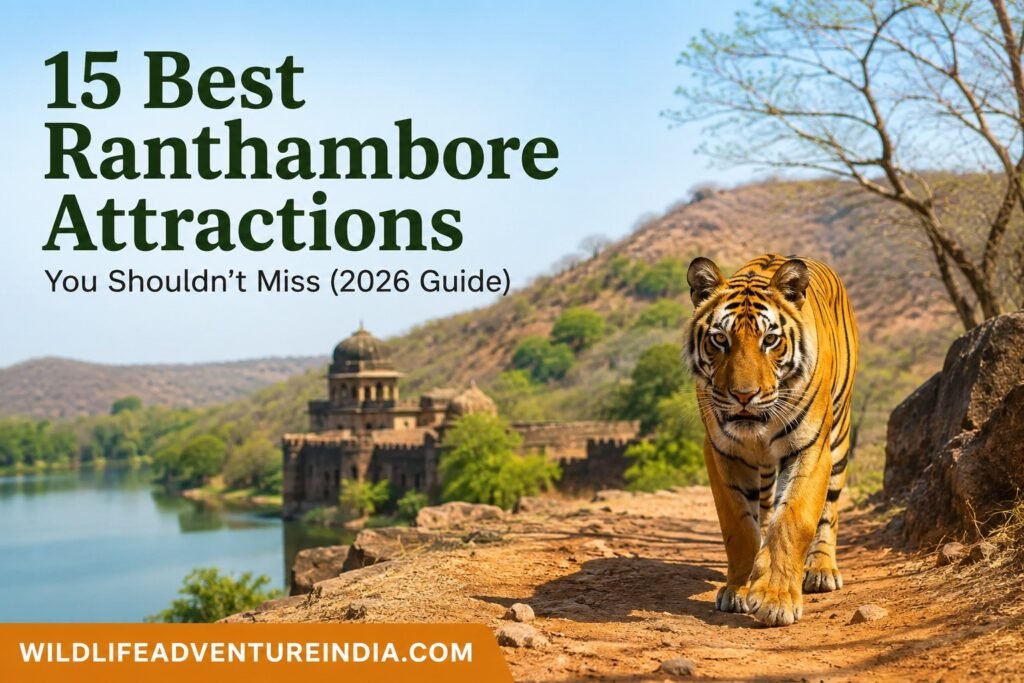
Most people land in Ranthambore with one goal: tiger, camera, done. Fair enough. But spend a week around here and you’ll realise the park is sitting on top of centuries of forts, lakes, and old stone that nobody bothers mentioning in the safari brochures. Skip all that and honestly, you’ve only seen half the place.
So here’s the full list — 15 Best Ranthambore Attractions, some inside the safari zones, some a short drive away. Doesn’t matter if you’ve got two rushed days or a full week, this should help you plan better.
1. Ranthambore Fort
Here’s a fun fact most tourists don’t know — you can actually stand inside a working national park and a 10th-century fort at the same time. That’s Ranthambore Fort for you. It’s part of the whole Hill Forts of Rajasthan UNESCO tag, and yeah, the climb gets you a little out of breath, but the view over the jungle from up top? Worth every step. Old temples, broken gateways, a few stepwells — plan on spending a good two hours poking around.
- Why Famous: UNESCO-listed hill fort standing inside a live tiger reserve, with temples and ruins spread across the hilltop.
- Distance from Sawai Madhopur: ~13 km
- Best Time to Visit: October to March, early morning for cooler weather and better views
- How to Reach: Accessible by cab from Sawai Madhopur takes about 25-30 minutes, followed by a short uphill walk/drive to the entrance.
2. Trinetra Ganesh Temple
Right inside the fort sits this temple, and it’s not your usual Ganesh mandir — this one’s got three eyes. Genuinely rare, apparently one of just a handful in the whole country. Here’s the part that gets people though: locals actually mail their wedding invitations to this temple. Like, before the actual wedding happens. Treat it as family, basically. Go on a Tuesday or during Ganesh Chaturthi if you want to see the place buzzing.
- Why Famous: One of India’s few three-eyed Ganesha shrines, known for the local custom of mailing wedding invites to the temple.
- Distance from Sawai Madhopur: ~13 km (inside Ranthambore Fort complex)
- Best Time to Visit: Tuesdays and during Ganesh Chaturthi for festive atmosphere; otherwise any morning
- How to Reach: Reached on foot within the fort complex after entering through the main gate.
3. Padam Talab
The biggest lake in the park, and probably the one you’ve already seen in a hundred Instagram photos without knowing its name. Sits right below the fort, water so still it practically doubles as a mirror. If a tiger decides to cool off near the banks — and they do, especially when it’s hot — this is where you want your camera ready.
- Why Famous: Largest lake in the park, famous for mirror-still water and frequent tiger sightings along its banks.
- Distance from Sawai Madhopur: ~13 km
- Best Time to Visit: Summer months (April-June) when tigers head to water more often; early morning safari slots
- How to Reach: It is the primary highlight and covering area of safari zone 3.
4. Raj Bagh Ruins and Raj Bagh Talab
If you’ve ever googled Ranthambore National Park, this is probably what showed up first. Old palace ruins, half swallowed by two lakes, arches and domes just sticking out of the water like something a film set designer dreamed up. During peak season everyone wants to be in this zone for exactly this reason — which also means it’s one of the harder sightings to nail down. Worth the wait though.
- Why Famous: Half-submerged 16th-century palace ruins between two lakes — the most photographed backdrop in Ranthambore.
- Distance from Sawai Madhopur: ~14 km
- Best Time to Visit: Winter and summer safari seasons alike; golden-hour light in the evening slot for photography
- How to Reach: Part of the Zone 3 safari route, accessible only with a valid safari permit and jeep/canter booking.
5. Jogi Mahal
An old hunting lodge, sits close to Padam Talab, built back when this land belonged to Jaipur’s royal family. Nobody stays here anymore — that stopped a while back — but the building’s still standing, and right behind it grows one of India’s biggest banyan trees. Branches spread out so wide it’s basically its own little forest. Even a five-minute stop here is kind of atmospheric.
- Why Famous: Former royal hunting lodge next to one of India’s largest banyan trees.
- Distance from Sawai Madhopur: ~13.3 km
- Best Time to Visit: October to March; pairs well with a Padam Talab safari stop
- How to Reach: It is passed en route during Zone 2 and 3 safaris and is not independently accessible outside safari.
6. Kachida Valley
Step a bit outside the usual safari zones and the terrain changes completely — rockier, drier, way less crowded. This is leopard and sloth bear country more than tiger territory, so if you’re chasing something other than stripes, Kachida’s your spot. Fewer jeeps around too, which honestly makes for a nicer drive.
- Why Famous: Rugged, rocky valley known for leopard and sloth bear activity away from the tiger-heavy zones.
- Distance from Sawai Madhopur: ~21.3 km
- Best Time to Visit: Winter mornings or late afternoon for cooler drives
- How to Reach: Covered by jeep safaris in the safari zone 5.
7. Surwal Lake
No permit needed here, which already sets it apart from most of this list. Come winter, the place fills up with migratory birds — flamingos, storks, cranes, the works. If your camera bag has more than a wildlife lens in it, this is where you bring out the long glass.
- Why Famous: Permit-free lake that turns into a migratory bird hotspot every winter.
- Distance from Sawai Madhopur: ~18 km
- Best Time to Visit: November to February for peak migratory bird activity
- How to Reach: Accessible by car or taxi; no safari booking needed.
8. Chambal Boat Safari
Short drive out of the park and you’re on the Chambal river instead, boat safari replacing the usual jeep. Gharials, muggers, and — if you’re lucky — the Gangetic river dolphin, which you’re simply not seeing on a land safari no matter how many drives you do. Nice change of scenery if you’ve already done a couple of jungle rounds and want something different.
- Why Famous: River safari featuring gharials, crocodiles, and the rare Gangetic river dolphin.
- Distance from Sawai Madhopur: ~45-50 km
- Best Time to Visit: October to March, morning boat slots for calmer water and better sightings
- How to Reach: By road via car/taxi to the Chambal jetty point, followed by a pre-booked boat ride.
9. Rajiv Gandhi Regional Museum of Natural History
Only four regional natural history museums exist in the whole country, and this is one of them. Not exactly thrilling on paper, but give it an hour — the exhibits on local geology and wildlife actually help make sense of what you’re seeing out on safari later.
- Why Famous: One of India’s four regional natural history museums, focused on the geology and wildlife of the region.
- Distance from Sawai Madhopur: ~4-5 km
- Best Time to Visit: Any time of year; a good filler activity between safari slots
- How to Reach: Short taxi or auto ride from Sawai Madhopur town.
10. Dastkar Ranthambore
Not a wildlife stop, this one — it’s a craft centre that supports women artisans from the villages around the park. Textiles, block prints, handmade stuff, and the money actually goes back into the community. Better souvenir than another keychain from a highway dhaba, if you ask me.
- Why Famous: Artisan craft centre supporting local women through textile and handicraft work.
- Distance from Sawai Madhopur: ~10.5 km
- Best Time to Visit: Daytime, weekdays for a quieter browsing experience
- How to Reach: By local taxi or hotel pickup; often combined with a visit to nearby attractions.
11. Ranthambore School of Art
A wildlife conservationist started this place to train local kids in tiger and wildlife painting. Walk through and you’ll see half-finished canvases, some for sale, mostly done by artists who grew up basically next door to the park itself. Quiet stop, but it adds something a straight safari trip won’t.
- Why Famous: Community art school training local youth in wildlife and tiger painting.
- Distance from Sawai Madhopur: ~3-4 km
- Best Time to Visit: Weekday afternoons when students are usually at work
- How to Reach: Short drive from Sawai Madhopur; easily combined with Dastkar Ranthambore in the same trip.
12. Malik Talab
Third of the core lakes, and the one everyone skips chasing Padam Talab or Raj Bagh instead. Their loss, kind of — decent bird activity, way calmer Ranthambore Safari experience, none of the jeep pile-up you get at the popular spots.
- Why Famous: Quieter of the three core lakes, good for birdlife without the crowds of Padam Talab.
- Distance from Sawai Madhopur: ~16-17 km
- Best Time to Visit: Winter mornings for bird activity
- How to Reach: Covered under select core-zone safari routes; check with your safari operator for zone coverage.
13. Kailadevi Wildlife Sanctuary
North of the main park, in the buffer zone, sits this sanctuary — temple dedicated to Kaila Devi, plus a fair number of big cats of its own. Less commercial than the core zones, less crowded too. Worth it if you’re staying longer and want off the standard circuit for a day.
- Why Famous: Buffer-zone sanctuary combining a Kaila Devi temple with regular big cat sightings.
- Distance from Sawai Madhopur: ~121 km
- Best Time to Visit: Navratri season for the temple, otherwise October to March for wildlife
- How to Reach: By road via private car or taxi; best planned as a half-day or full-day trip from Sawai Madhopur.
14. Sawai Madhopur Town
This is where basically everyone bases themselves — hotels, safari counters, the whole setup. But the town itself deserves a walk too. Local markets, bangles, street food, small-town Rajasthan without the jungle-lodge polish.
- Why Famous: Gateway town to Ranthambore, known for its local bazaars and easy rail connectivity.
- Distance from Sawai Madhopur: ~2-3 km
- Best Time to Visit: Evenings, for market walks and street food
- How to Reach: You can book a local taxi or private one.
15. Rameshwar Ghat
Three rivers meet here — Chambal, Banas, Seep — and locals treat the spot as sacred, with an old Shiva temple sitting right at the confluence. Quieter, more spiritual kind of stop. Good half-day add-on if you’re mixing wildlife with a bit of culture.
- Why Famous: Sacred confluence of three rivers with an old Shiva temple, popular with pilgrims.
- Distance from Sawai Madhopur: ~60-65 km
- Best Time to Visit: Maha Shivratri for the temple; October to March for pleasant travel weather
- How to Reach: By car or taxi via road; often combined with the Chambal Boat Safari trip since both lie in the same direction.
Read Also: How to Book a Ranthambore Safari with Wildlife Adventure India?
Frequently Asked Questions
Three or four days does it, honestly — enough for 2-3 safaris plus the fort, lakes, and a couple of nearby spots. Two days and you’re basically stuck to safaris and the fort, nothing else.
Yep. No permit needed for the fort itself, even though it sits inside the reserve boundary.
It’s a totally different vibe — river wildlife instead of the usual tiger-and-deer routine. Most people who’ve done a few jeep drives already find it a nice change, not a repeat.
Zones 1 through 5 usually cover that stretch and tend to have higher sighting rates, but let’s be honest — tigers don’t really care about your itinerary.
Nope, it’s outside the core zones and doesn’t need a permit either, so you can just drive there yourself.
Winter, roughly November to February. That’s when the migratory crowd shows up in the biggest numbers at spots like Surwal Lake and Malik Talab.
Timings shift around depending on season, so it’s worth a quick check ahead, or just ask your hotel to confirm before you plan your day around it.
Most hotels cluster around Sawai Madhopur, but some properties sit closer to specific gates depending on which zones you’ve booked.
