Gir National Park — The Last Refuge of the Asiatic Lion
Gir is one of those rare, genuinely humbling wildlife destinations that stops you in your tracks the moment you enter it. It's tucked into the Saurashtra peninsula of Gujarat, spread across the Junagadh, Gir Somnath and Amreli districts of Western India. This legendary sanctuary is the last home on Earth of the Asiatic lion outside captivity, wrapped up in dry deciduous teak forests, thorny scrubland and rocky ravines carved by the Hiran and Shetrunji rivers, feeling utterly untouched by the outside world, for real.
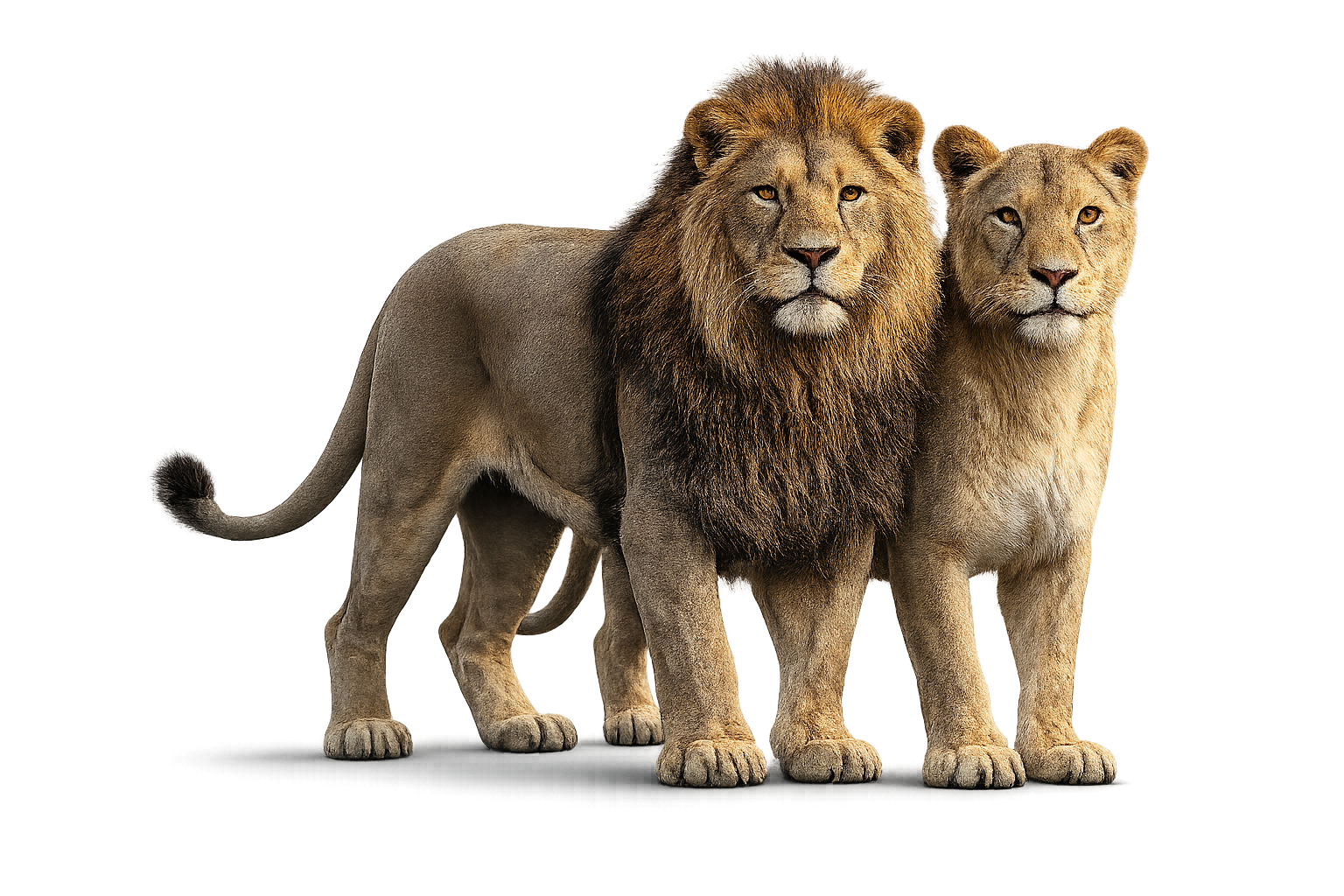
The park is home to the iconic Asiatic Lion, Indian Leopard, Sambar, Chital, Nilgai and the elusive Chowsingha (four-horned antelope) — together forming the beating heart of Gir's wilderness. Every jeep safari here is an experience you carry long after you leave, and the sanctuary's core zone alone is threaded with 13 designated safari routes, each winding through a slightly different mix of teak forest, riverbed and open grassland. Whether you watch a lion pride lounging beneath an acacia at golden hour, catch a leopard slipping through the dry riverbed at dawn, or see a herd of chital scatter as an alarm call echoes through the teak, every moment inside Gir feels like the wild is showing you something truly rare.
Gir spans across a core zone of nearly 259 sq km, and also has a total protected area — combining the national park and surrounding sanctuary — that tops 1,412 sq km. Here it feels like a breathtaking mix of dry teak forests, savannah grassland and riverine belts, sort of blended together in a natural, quieter kind of way. You get this sense that the place is alive all the time, with over 300 species of birds and more than 35 species of mammals, and the lion density here is as astonishing and rare as you'll find in any protected area on earth.
But Gir isn't just one single experience, and that's honestly part of what makes it so special. Beyond the core jungle safari and its 13 routes, the landscape opens up into three other worlds worth exploring. There's Devalia, a fenced interpretation zone tucked within Gir itself, offering a shorter, more controlled safari where sightings feel almost guaranteed, which makes it a favourite with families and first-timers alike. Then there's the trail toward Kankai Mata Temple, a remote forest shrine sitting deep inside the sanctuary, reachable only through a permitted safari that winds through some of Gir's quietest, least-visited stretches. And a little further out sit the Girnar Hills, a sister sanctuary built partly to ease the tourist load off Gir's core zone, offering its own single-route safari through forest that feels every bit as wild, just with far fewer vehicles sharing the track.
So whether you're a wildlife lover, a bird photographer, or a family hunting for something real and unforgettable, Gir comes through every single time, no hesitation. It is not just a national park. It is the sole surviving home of the Asiatic lion, and living proof that conservation, when done right, can bring a species back from the very edge of extinction.
Quick Facts
Everything you need to know about Gir National Park at a glance.
1,153.42 sq. km Surrounding Wildlife Sanctuary (Buffer Zone)
300+ Bird Species
35+ Reptile Species
400+ Plant Species
History of Gir National Park
The story of Gir begins in 1879, when Mahabat Khan, the sixth Nawab of Junagadh, alarmed by the dwindling number of lions, banned all hunting within his territory without state permission — an extraordinary act for its era, decades before conservation existed as an idea anywhere. By the early 1900s, a severe famine combined with intense trophy hunting had reduced the lion population to just 15. The crisis reached Viceroy Lord Curzon himself, who cancelled his own planned hunting trip to Gir and urged local rulers to begin protecting the species instead. Nawab Sir Muhammad Rasul Khanji reinforced the hunting ban in 1900, and by 1913 the British colonial government had formally declared the region a protected area.
Independent India carried this legacy forward. In 1960, the Indian government officially banned hunting across the Gir region, and in September 1965, the Forest Department designated it the Gir National Park and Wildlife Sanctuary — at a time when the lion population stood at just 177. A difficult but necessary chapter followed in 1972, when the relocation of Maldhari pastoral families began, easing the grazing pressure hundreds of cattle herds had placed on the forest. In 1975, Gir was elevated to full National Park status, and in 1977 roughly 1,000 mugger crocodiles were released into the Kamleshwar Dam, giving the park one of India's densest crocodile populations.
Recovery accelerated from here — the population reached 359 by 2005, and the 2013 Supreme Court judgment on inter-state lion translocation pushed conservation beyond Gir's own boundaries. Project Lion, launched in 2020, aimed at long-term habitat and genetic security, coinciding with a census of 674 lions. By 2025, that number had climbed to 891, with Gir still holding over 43% of the total population — proof that patient, century-long protection can bring a species back from just fifteen survivors to India's most celebrated conservation success.
Types of Safari in Gir National Park
This is the part that usually confuses people the most, because "Gir" isn't just one single area — it's a cluster of different safari types, and safari type uses a different type of vehicle. Here's the simple breakdown:
Gir Trail Safari
(Core Jungle Safari)
Open Gypsy only
The real, wild jungle safari — deep inside the actual sanctuary, spread across 13 designated routes.
Genuine wildlife sightings in a completely natural, unfenced habitat.
Devalia Safari
(Interpretation Zone)
Bus Safari + Cage Jeep Safari
A fenced, 412-hectare controlled zone built to represent Gir's habitat in a compact space, with near-guaranteed lion sightings. The Cage Jeep is used specifically to get close to the carnivore enclosures.
Families, first-timers, and anyone short on time who still wants a reliable lion sighting.
Girnar Safari
(Wildlife Sanctuary)
Open Gypsy
A separate sanctuary bordering Gir, set against the Girnar hills — quieter and less crowded than the main park.
Visitors wanting a more exclusive, personal safari away from the main sanctuary's crowds.
Kankai Safari
(Forest Temple Trail)
Closed vehicles only — Innova, Sumo, Bolero
A long, ~25 km forest trail leading to the remote Kankai Mata temple. This is not a typical "jungle safari" for lion sightings — it's more of a scenic, pilgrimage-style forest drive, done in closed vehicles because of the distance and rough terrain.
Travellers who want to experience Gir's deep forest and a temple visit together, rather than a dedicated wildlife-spotting trip.
Best Time to Visit Gir National Park
Winter — The Best Overall Season
Winter is considered the best time to visit Gir National Park, with temperatures ranging from 10°C to 22°C, creating pleasant conditions for wildlife exploration. The cooler climate prompts lions and other animals to be more active during daylight hours and draws them to predictable water sources, making this the ideal window for comfortable, extended safaris. October, November and February are the most comfortable months, as the temperature stays neither too cold nor too hot, though this is also peak tourist season, so booking safaris well in advance is essential.
Summer — Best for Guaranteed Sightings
Summer is the best season for wildlife lovers wanting maximum animal sighting, even though temperatures can climb up to 42°C. For those specifically wanting to see the Asiatic Lions, April and May are considered the best months, since the intense heat pushes animals out of dense cover and toward waterholes, making sightings far more predictable. Mornings and late evenings remain the most comfortable and rewarding time for safaris during this season.
Monsoon — The Park Stays Closed
The park remains closed from mid-June to mid-October each year due to heavy rainfall, making the core zone inaccessible for safaris during this period. However, the Devaliya Safari Park remains open through the monsoon, offering a unique opportunity to experience a limited safari in a more controlled environment — making Devalia the only option for visitors travelling to Gir during the rains.
Flora and Fauna of Gir National Park
Gir National Park is tucked into the Saurashtra peninsula of Gujarat, where dry teak forests kind of loosen up into thorny scrubland, rocky ravines and open savannah grassland carved by the Hiran and Shetrunji rivers. Together, these diverse habitats create the only surviving wild home of the Asiatic lion anywhere on Earth.
Flora
Gir is mostly classed as a dry deciduous forest, where the Teak tree basically dominates most parts of the sanctuary, forming nearly half of the park's total vegetation cover. In the riverine belts things shift, you start seeing broad-leaved, moisture-retaining species clustered along the Hiran and its tributaries, giving way here and there to open scrub and savannah stretches that feel almost semi-arid. More than 400 species of plants have been noted within the park, from tall teak and banyan to flowering trees, thorny shrubs, and medicinal herbs that local Maldhari and tribal communities have traditionally relied on.
The open grasslands spread through the park are pretty important, mostly because they sustain large grazing numbers of chital, nilgai and chinkara, and these in turn help maintain Gir's healthy lion and leopard density. Also, a bunch of medicinal and ethnobotanical plants used in traditional Maldhari and local healing practices are recorded here and there through the buffer forest areas, so yeah, there is that too.
Fauna
The wildlife in Gir National Park is kind of remarkably diverse for its size, and the park logs over 38 species of mammals, more than 300 species of birds, 37 species of reptiles, plus around 2,000 recorded species of insects through the core and buffer zones.
Gir's reptile world has Indian rock pythons, monitor lizards, marsh crocodiles, star tortoises, several types of cobra, plus loads of smaller lizards and snakes, that you can often spot near the park's rivers, the Kamleshwar Dam and its scattered waterholes, here and there. The Kamleshwar Dam in particular is known for holding the highest concentration of marsh crocodiles found anywhere in India.
With more than 300 recorded species, Gir is kinda a solid little reward for birdwatching people, you can get sightings of Crested Serpent Eagles, Bonelli's Eagles, Indian Pittas, Paradise Flycatchers, and plenty of owls as well as woodpeckers, including the pygmy woodpecker and crested treeswift. The park's waterholes and riverine belts also pull in a bunch of migratory birds during winter, so the early morning hours around Gir's core zone become really popular with folks doing serious bird photography.
How to Reach Gir National Park
Gir sits in the Saurashtra peninsula of Gujarat, and thanks to the state's strong road, rail and air network, reaching it is fairly straightforward from most major Indian cities.
By Air
Diu Airport feels like the closest airport to Gir National Park, it's about 63 km away, however it has limited flight choices, mostly you'll find links to Mumbai. Rajkot Airport is the bigger one in order for connectivity, roughly 173 km out, with flights to major cities such as Delhi, Mumbai and Ahmedabad, so it's the more practical pick for travellers who are coming from farther afield.
Then there's Ahmedabad Airport, around 402 km away, which is better suited if someone is stitching their Gir visit together with other Gujarat attractions. From any of those airports, a private taxi or a pre-arranged transfer is usually the simplest way to finish the rest of the route to Sasan Gir.
Second Option: Rajkot Airport · Roughly 173 km out
Also Useful: Ahmedabad Airport · Around 402 km away
From Airport: A private taxi or pre-arranged transfer to Sasan Gir
By Rail
Sasan Gir has a little railway stop, sort of near by the park itself, just a short distance away, although it is not really well linked with big cities in a direct way. The easiest, and also the nearest railheads are Veraval which is about 64 km out, and Junagadh at roughly 106 km, and both of them get regular trains from Ahmedabad and Rajkot.
Rajkot Railway Station, around 165 km from Gir, feels like the bigger, better connected option for travellers who are coming from more distant places, where a taxi then covers the remaining part of the trip. From Veraval or Junagadh, reaching Sasan Gir by road takes around 1 to 2 hours, depending on how fast the route is.
Nearest Railheads: Veraval · Approximately 64 km out
Also Useful: Junagadh · Roughly 106 km out
Better Connected Option: Rajkot Railway Station · Around 165 km from Gir
By Road
Gir is well connected with nearby cities, through Gujarat's state highway network, and there are regular GSRTC and private buses running from places like Junagadh, Rajkot, Veraval, Somnath, Ahmedabad and Diu. From Somnath to Sasan Gir you're looking at only about 40 km or so, roughly an hour's drive, so it becomes one of the favorite quick combo rides for most visitors.
Ahmedabad to Sasan Gir is around 350–375 km, usually 6–7 hours on the road, while Mumbai to Gir is a longer haul, roughly 800–840 km by road. The journey itself goes through the scenic countryside of rural Gujarat, so the drive feels genuinely pleasant for anyone who has some extra time to spare.
From Ahmedabad to Sasan Gir: Around 388 km · Usually 6–7 hours
From Mumbai to Gir: Roughly 800–840 km by road
Buses: Regular GSRTC and private buses from Junagadh, Rajkot, Veraval, Somnath, Ahmedabad and Diu
Route Chart
Distance from Major Cities to Gir National Park.
Do's and Don'ts
Important guidelines to follow during your visit to Gir National Park.
✓ Do's Inside the Park
✕ Don'ts Inside the Park
Frequently Asked Questions
Essential information about location, safari zones, wildlife, and travel details for Gir National Park.
Plan Your Gir Safari & Attractions Tour
Let us craft the perfect itinerary — combining Asiatic lion safaris with the best temples, the Girnar hills, and the teak forests and rivers around Gir National Park.