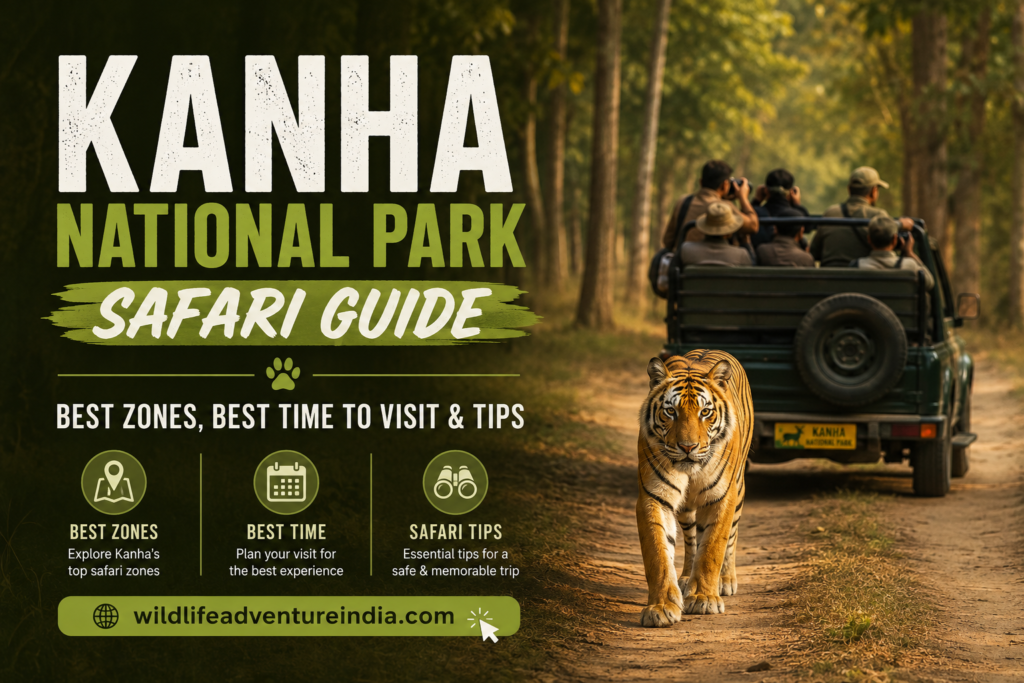
Most people who’ve actually been to Kanha don’t lead with the tiger story. They lead with the forest itself — how you’re driving through a wall of sal trees, thick enough that you can’t see ten feet off the track, and then it just opens up. A meadow, out of nowhere, stretching further than you’d expect. First time it happens, it catches you off guard. By your third safari, you’re waiting for it.
But okay, practicalities first, because that’s probably why you’re here. Where Kanha actually is, when to go, which zone gets you the tiger, what it costs, where to sleep that isn’t a random highway resort. This is the version of that advice you’d get from someone who’s already made the annoying mistakes so you don’t have to.
Where Is Kanha National Park, Actually?
Madhya Pradesh. Specifically the Mandla and Balaghat districts, tucked into the Maikal range of the Satpura hills. If you’ve looked at other central India tiger reserves, Kanha is on the bigger side — core zone alone is close to 940 sq km, and once you count the buffer area the whole thing crosses 2,000 sq km.
That size actually matters more than people assume going in. It’s a big part of why a Kanha jungle safari doesn’t get old even after a few visits — there’s just too much ground for any two drives to look the same.
The park itself goes back to 1955, so it’s one of the older national parks in independent India, and it joined the Project Tiger network in 1973. There’s also that bit of trivia everyone mentions — the idea that these forests inspired Kipling’s Jungle Book. Nobody knows exactly how literal that connection is. But stand in the middle of the bamboo here for five minutes and you’ll get why people believe it anyway.
It’s Not Just About the Tigers
Sure, most people come for a Kanha tiger safari, and that’s fair — the Bengal tiger population here is genuinely one of the strongest in the country. Ask the guides though, and they’ll usually point you toward the hard-ground barasingha instead. This swamp deer had dropped below 100 individuals by the mid-1960s. That’s the kind of number where a species usually just doesn’t come back. It did, here. Kanha is now the only place on the planet where this deer survives in the wild, which is a bigger deal than most visitors realize when they first hear it.
Beyond the tiger and the barasingha, there’s a decent lineup: leopards (deeper in the tree cover, harder to catch), Indian gaur (massive, often in herds), dhole — wild dogs that hunt in packs — sloth bears (mostly nocturnal, shy), and over 300 bird species if you’re the type who carries binoculars.
A Bit of History, Because It Explains Why the Park Looks the Way It Does
Long before any of this was official, the Gond and Baiga tribes lived on this land. Their knowledge of the forest — what grows where, how the animals move — shaped a lot of what happened later, even if nobody wrote that down properly at the time.
The first forest rules showed up in 1862, mostly about controlling timber, not protecting wildlife. By 1879 it was a reserved forest, still purely about resource management. Then in the 1930s things shifted — the Banjar valley became a sanctuary in 1933, Hallon valley followed in 1935. The 1940s were a bad decade though. Hunting by royal families and landowners went largely unchecked, and both tiger and barasingha numbers crashed.
On 1st June 1955, the two sanctuaries merged into what we now call Kanha National Park. A dedicated barasingha breeding program started in 1965. In 1973, Kanha became one of the founding reserves under Project Tiger. Through the 70s and 80s, villages inside the core zone were gradually moved outside the boundary, and the wildlife slowly came back.
Picking a Safari Zone
Get this wrong and you can spend three hours looking at nice scenery with zero big cats. Get it right and, well, you know why you came.
Core zones — these close during monsoon:
Kanha Zone is the original heartland. Open meadows, sal forest, bamboo, decent odds for both tigers and barasingha. Kisli Zone sits right next to it but feels denser, thicker canopy, and it’s reliable for gaur, sambar, chital. Mukki Zone is usually the one people point to for the best tiger odds in the whole reserve, and it’s a bit further out so you get fewer crowds too. Sarhi is newer, quieter, more scenic — better for birdwatchers than for guaranteed tiger sightings, honestly.
Buffer zones stay open most of the year. Khatia is the busiest gate, good if you want to pair the safari with a look at village life nearby. Phen follows a river valley and has a different feel altogether, decent for leopards. Sijhora and Khapa are the quiet ones — low crowds, good if you just want a calm drive without chasing a specific sighting.
Attractions Worth Seeing Beyond the Jeep Window
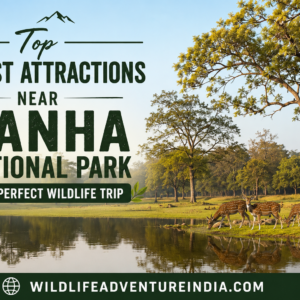
Kanha Meadow — locally called Kanha Maidan — is the most photographed spot in the park. Barasingha graze here at dawn, and tigers cross the open grass more in summer once it thins out. Bamni Dadar is the “sunset point,” a plateau with views over the sal canopy that are honestly worth the drive on their own. Shravan Tal is a quiet forest lake with a Ramayana legend attached to it, popular with both pilgrims and birdwatchers.
There’s also the Kanha Interpretation Zone and Museum near Khatia gate — worth ten minutes before you head in, since it covers the ecology and the barasingha recovery story properly. The Banjar River Valley near Mukki is a key water source and good for spotting kingfishers. And if you get the chance, a respectful visit to a Baiga or Gond village near the buffer zone adds a layer to the trip that most people skip and later wish they hadn’t.
Check out our full guide to Top Attractions in Kanha .
Other Things Worth Doing
Not everything here has to revolve around a jeep. Birdwatching across the meadows and riverside stretches is genuinely rewarding. Early mornings and late afternoons are best for photography. There are cycling trails along the buffer zone edges if you’d rather move slower. Sunset walks up to Bamni Dadar. Jungle camping at a few eco-lodges nearby, if you don’t mind trading comfort for atmosphere. Tribal bazaars near the entry gates for handicrafts. And some of the jungle resorts do open-air bush dinners, which sound like a gimmick until you’re actually sitting there under the trees.
The Rivers Holding the Whole Ecosystem Together
The Banjar River is the big one — runs along the southern edge near Mukki and is a critical water source for tigers and gaur, especially in summer. The Halon River flows through the north and gave its name to the old Hallon sanctuary that helped form the park in the first place. Tanneur is smaller, seasonal, along the boundary. The Narmada doesn’t actually run through the park, but it originates nearby at Amarkantak and shapes a lot of the region’s cultural identity. Same with the Son River, which also rises near Amarkantak and helps connect Kanha to forests further east.
Best Time to Visit Kanha
October to February is cool and pleasant, and also the most crowded stretch. Mornings get properly cold, so bring layers — people underestimate this. Good season for families, easy safaris, comfortable weather.
March to June is hot, no way around it, but this is when the sightings peak. Waterholes shrink, animals cluster around whatever’s left, and tigers become far more predictable during the early morning and late afternoon drives. Most serious safari-goers actually prefer this window despite the heat.
July to September, the core zones shut down completely — 1st July to 30th September — so the forest can recover without disturbance. Buffer zones stay open if you still want to visit during monsoon, though the experience is obviously different.
What a Kanha Safari Actually Costs, and When
Jeep (Gypsy) safaris take up to 6 people, run roughly 3 to 4 hours. The cost breaks down into a permit fee, vehicle charge, guide fee, and a facilitation charge on top.
Summer timings run morning 5:30 to 10:00 or 11:00 AM, evening 3:00 to 6:00 PM. Winter shifts to morning 6:30 to 11:00 AM, evening 2:00 to 5:30 PM.
Worth knowing: evening safaris don’t run on Wednesdays at all. Core zones are closed July through September, no exceptions. And you’ll want to book 45 to 90 days ahead for core zones, since the forest department strictly caps how many vehicles get into each zone per day.
Where to Actually Stay
Skip the highway resorts if you can help it — you lose too much time getting to the gate. The Madhya Pradesh Forest Department and MP Tourism run a few rest houses right at the forest edge instead: Kisli Forest Rest House, Khatia Jungle Camp, Mukki Forest Rest House, MPT Baghira Jungle Resort (one of the only properties actually inside the core zone), and MPT Safari Lodge Mukki near the Banjar River. None of it is fancy. No pools, no spa menus. But you fall asleep to actual jungle sounds, and you’re at the gate in minutes for that first safari, which honestly matters more than people expect until they’ve tried both ways.
Nearby Places Worth Folding Into the Trip
Mandla, about 60 km out, sits on a bend of the Narmada with some old temples and Gond-era history. Jabalpur, 130 to 165 km, is the main transit hub and also home to the Bhedaghat Marble Rocks, worth a stop even if you’re just passing through. Amarkantak, around 160 km, is a pilgrimage town where the Narmada and Son rivers both begin. Pench National Park (146 to 210 km) is another Kipling-linked reserve and pairs naturally with Kanha. Bandhavgarh, about 210 km, has very high tiger density and a historic fort worth seeing. Nagpur, 260 km, is a major air and rail hub if you’re coming from the south or west. And Tadoba Andhari Tiger Reserve, further out at 313 km, gives you a drier, more open landscape — a solid contrast if you’re doing a longer central India trip.
Getting There
By air, Jabalpur is closest at around 165 km, with regular flights to Delhi, Mumbai, and Bhopal. Nagpur, about 260 km, has broader connectivity if you’re flying in from further away. By train, Gondia (roughly 130 km) and Jabalpur (165 to 170 km) are your best bets, both well connected to major cities. By road, Kanha links up well with Jabalpur, Nagpur, and Pench, and honestly a self-drive trip out here is more popular than people assume.
A Few Jungle Rules
Keep your permit on you the whole time, travel with an authorised guide, stick to earth tones for clothing, and keep the noise down. No smoking, no loud music, no feeding or approaching wildlife. Don’t ask your driver to leave the route just because you heard something in the bushes. And leave the place the way you found it — that one shouldn’t need saying, but here we are.
FAQs
Its tiger population mostly, along with the sal and bamboo forests and the fact that it’s the last wild home of the hard-ground barasingha. Also the loose Jungle Book connection people love bringing up.
March through June, especially the later stretch — April to June — when the dry conditions push tigers toward waterholes and open meadows.
Core zones shut every year from 1st July to 30th September, reopening 1st October. Buffer zones run year-round.
Four core zones — Kanha, Kisli, Mukki, Sarhi — plus buffer zones covering Khatia, Khapa, Phen, and Sijhora.
Mukki and Kanha zones, generally, because of that mix of dense forest and open grassland.
Yes, Pench and Bandhavgarh are both common add-ons for a longer central India wildlife circuit.